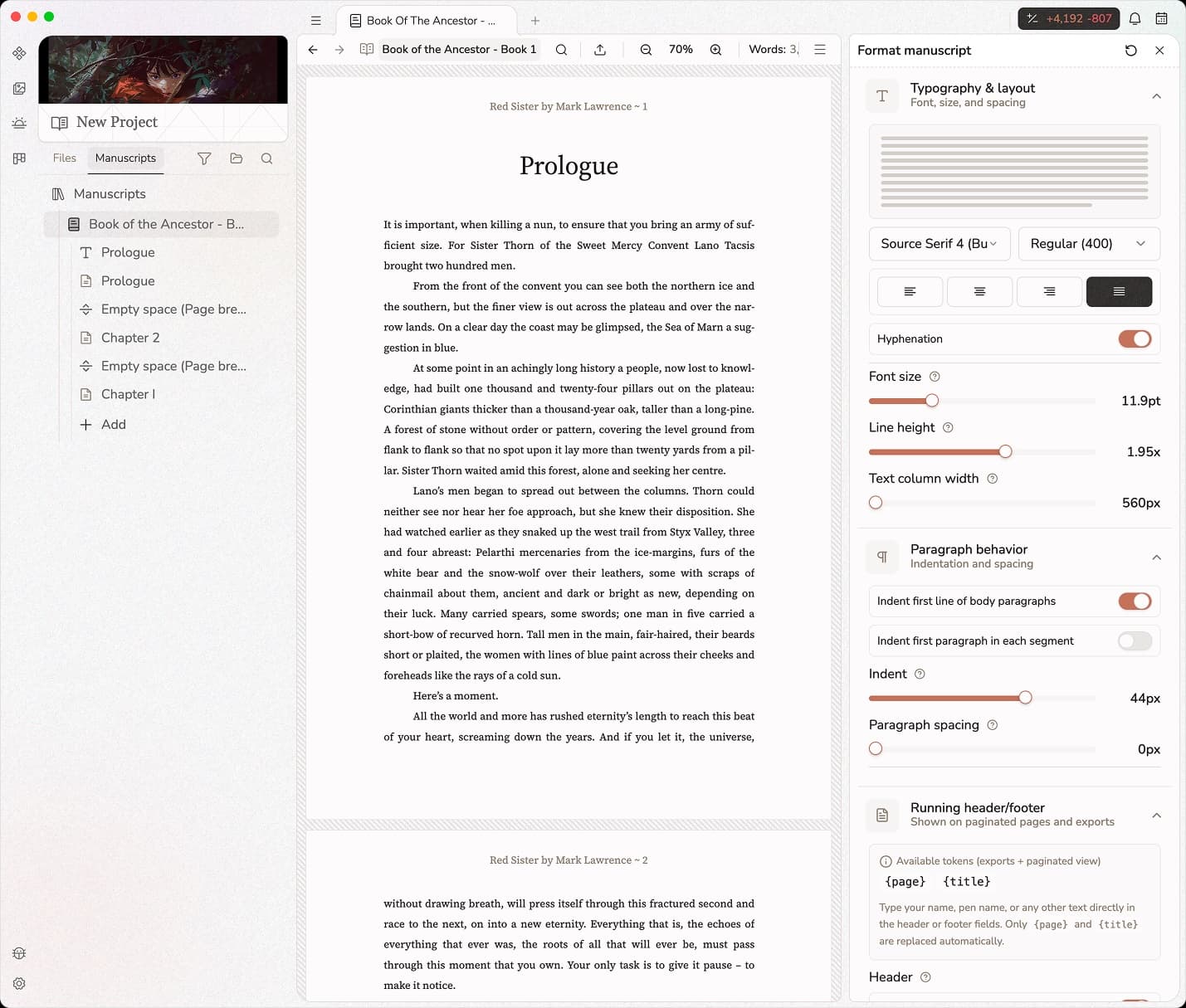
Rich Text Editor
A fancy editor that should have everything you need while also looking sleek. You can link things, add images, format text, tables and really anything.
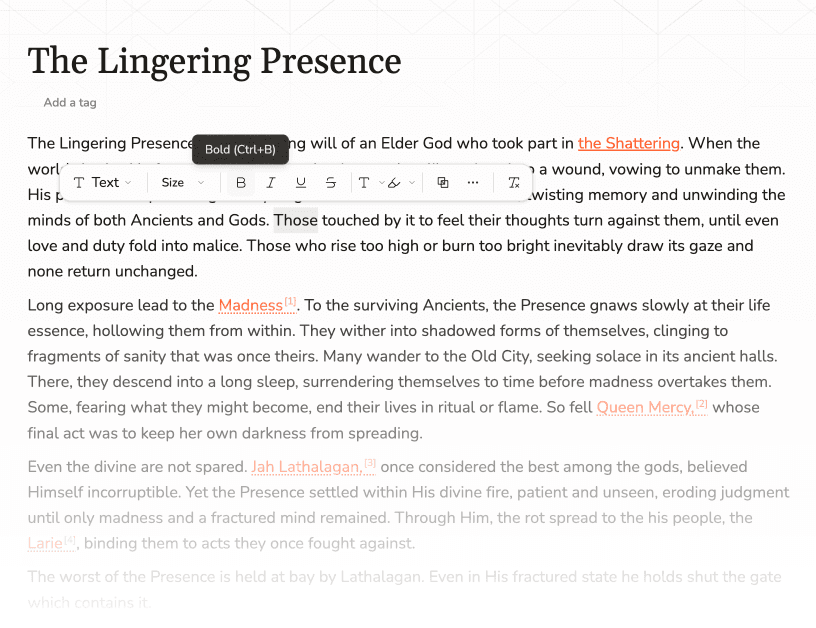
An editor that grows with your story, with all the features you need to write and worldbuild.
Come on, it is free.
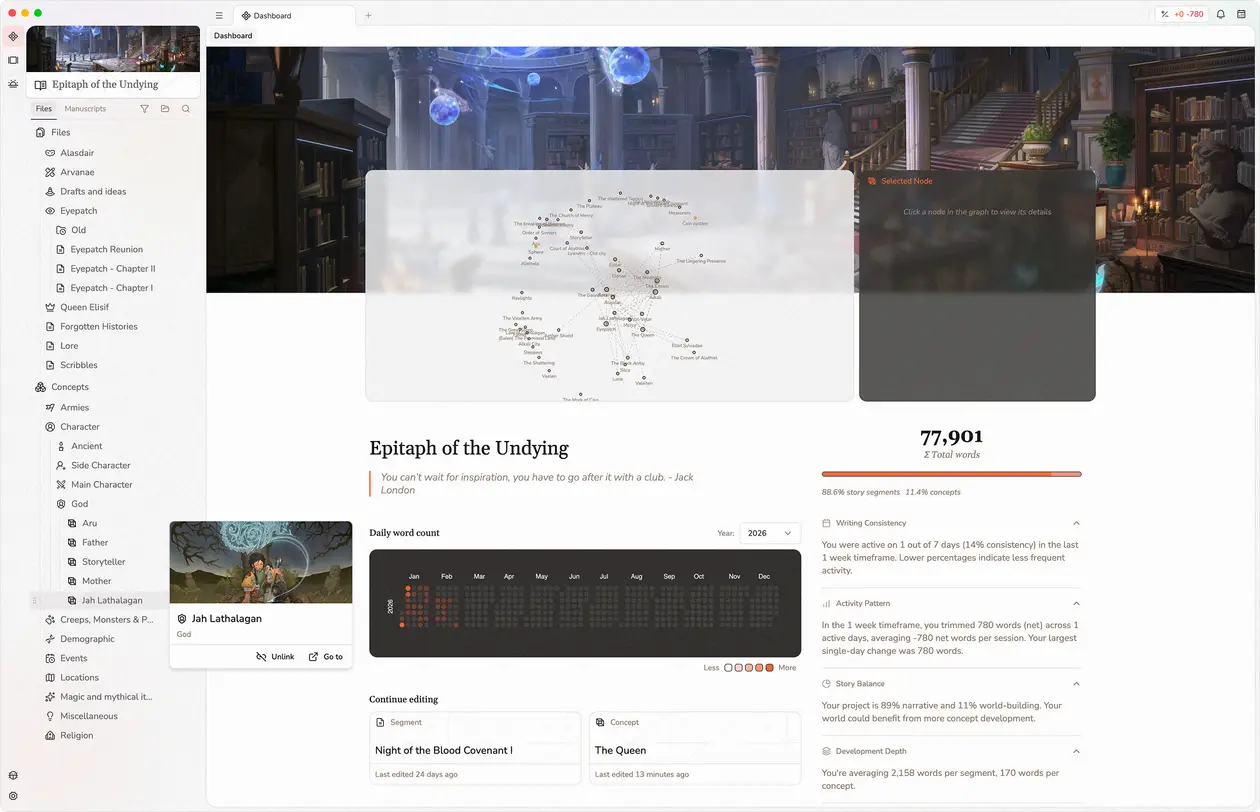
YOUR STORY + YOUR CONTEXT
Imagine splitting your work between a bunch of apps when you can just use one ;)
ONE PLACE FOR ALL YOUR CREATIVE WORK
Plan, draft, connect, and revise inside one writing masterpiece.
They say the best way to understand a product is to see it in action... I don't have a video demo, so you will just have to:
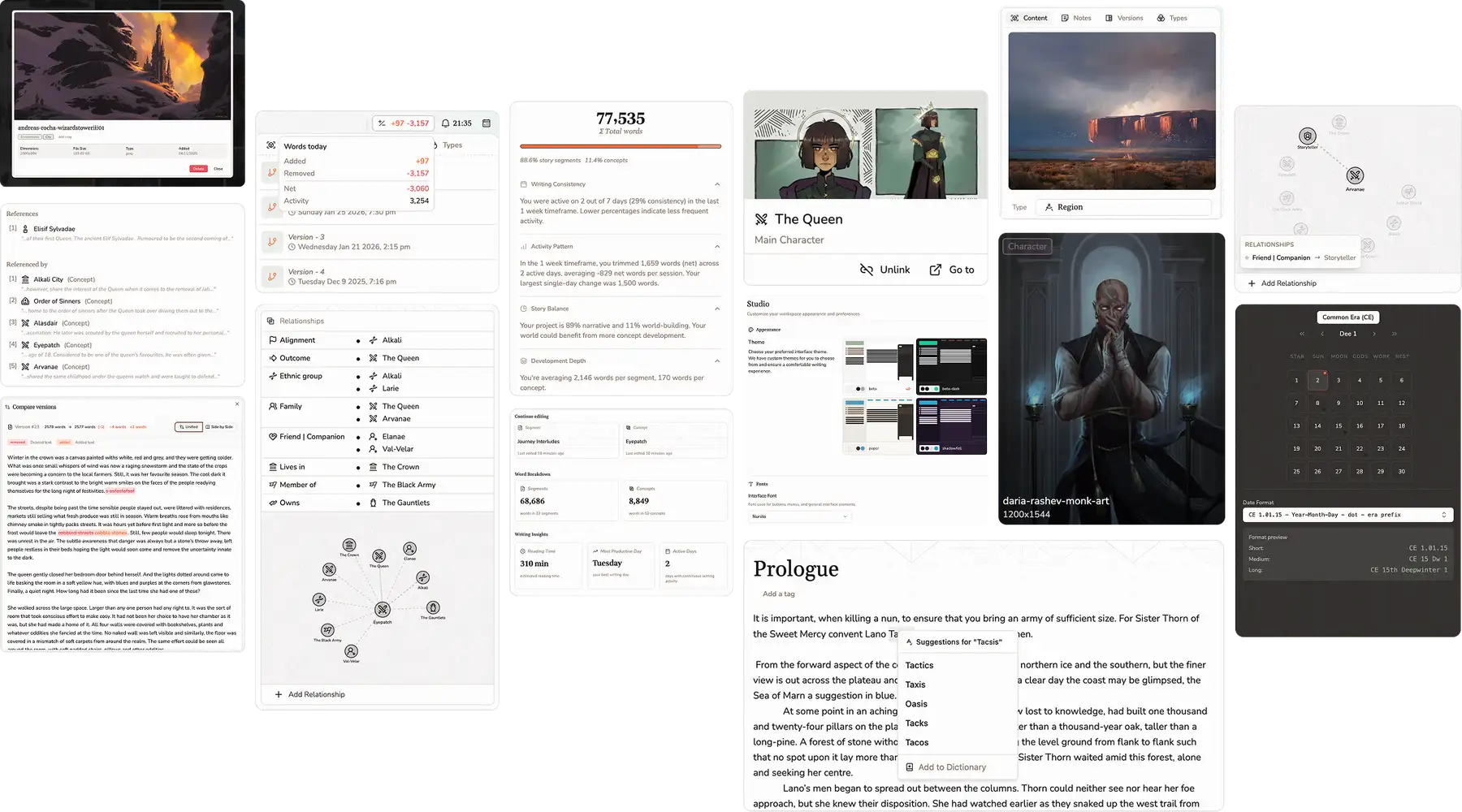
A fancy editor that should have everything you need while also looking sleek. You can link things, add images, format text, tables and really anything.
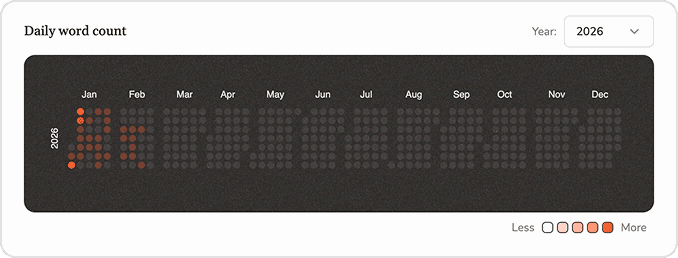
See how many words you have added and removed each day, so even in your worst day, you can see that little indication of progress.
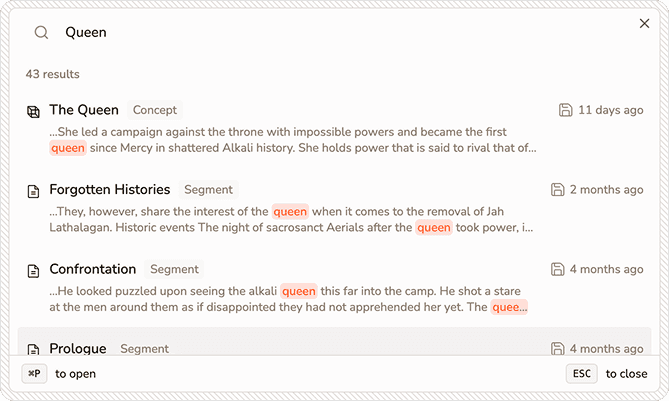
When the project gets big. I mean, really big. It is still easy to find. Simply search and you're already there.
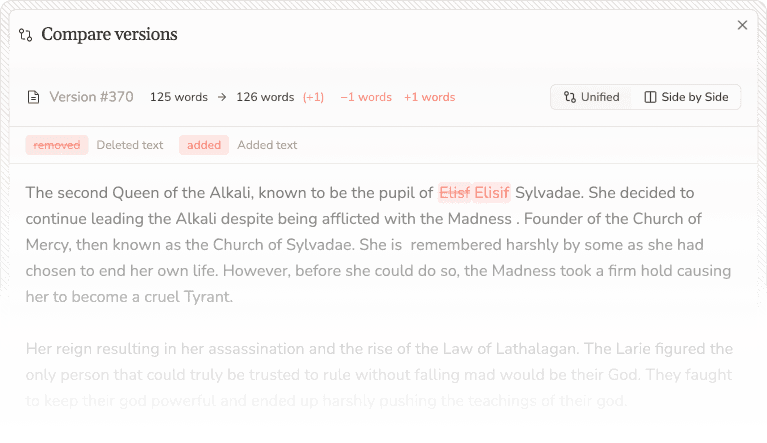
Sometimes a draft was better three versions ago. This makes it easy to go back and experiment without worry or having to duplicate the file.
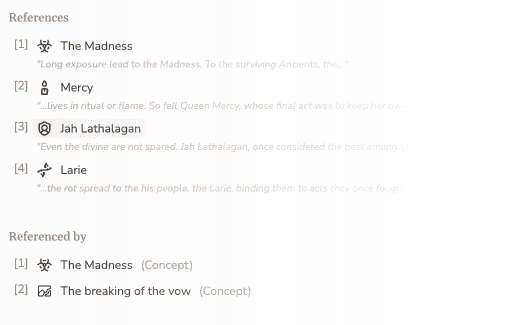
Whenever you meantion a segment or a concept from the different file, you automatically create cross references which can link you back.
I like themes, and I like different ones depending on my mood and the time of day. And now you can also create custom themes and share or import them.
Many themes.. a lot more than 3
catppuccin-mocha
Create your own calendar system, seasons, moons, whatever you need. And use it in the app as if it were a normal calendar.
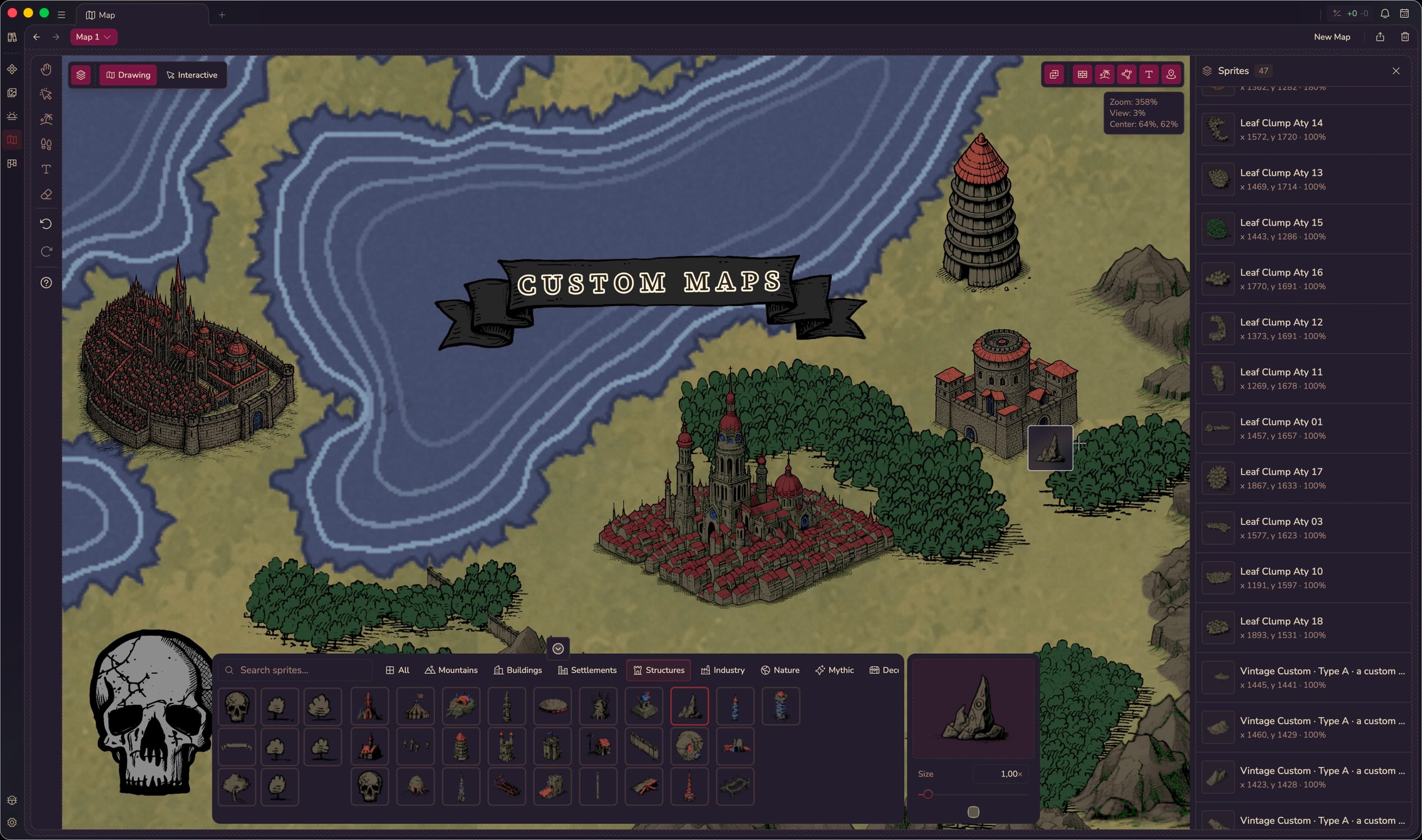
A full fledged map making tool inside Writality. Draw and style your world, add regions and roads, export as many high definition maps as you want, and connect it all back to your story. No holding you back. Still free.
Oh an please, if you do make a nice cool map. Share it with us on Discord. We would love to see it and show it off.
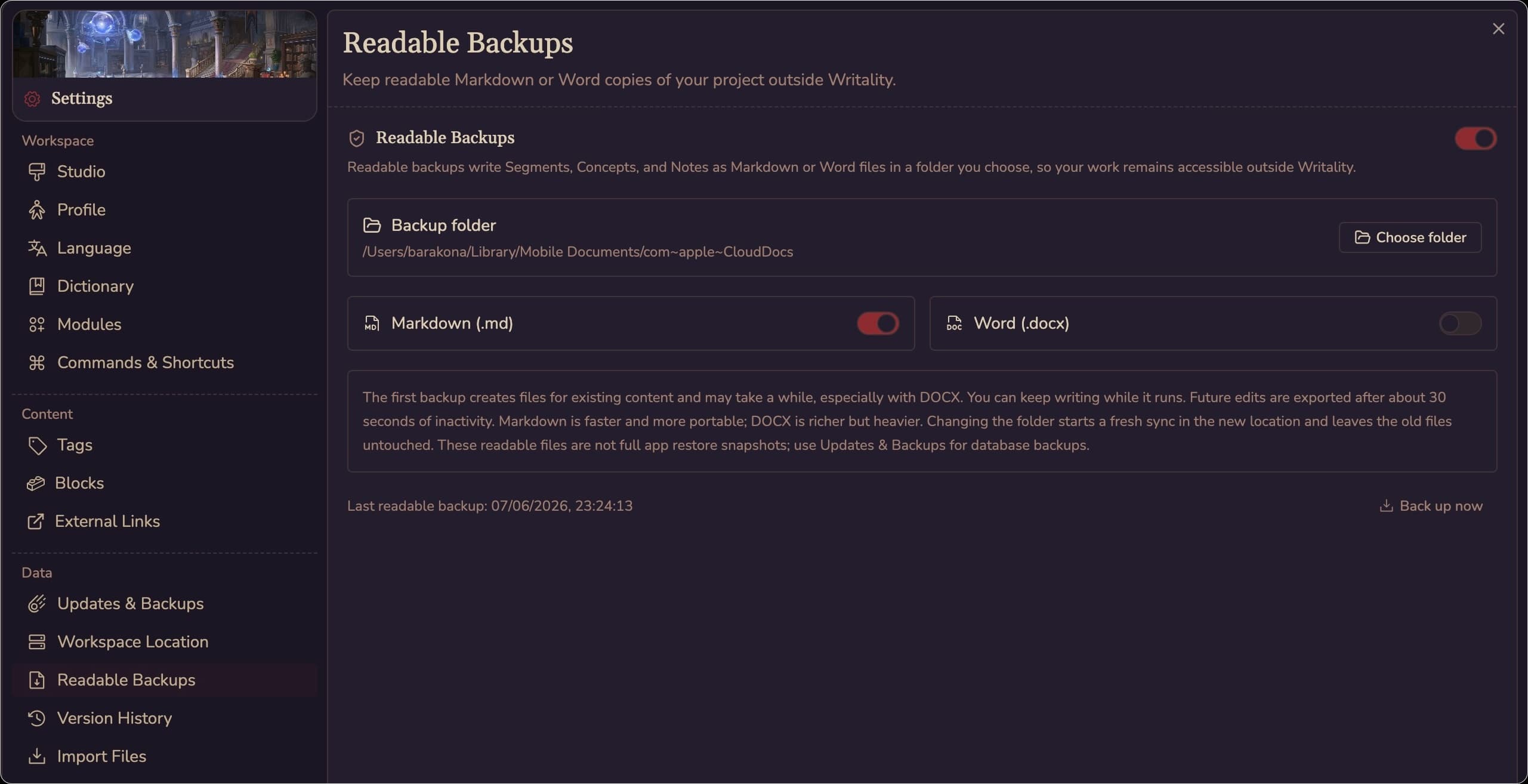
Your data belongs to you. Writality uses SQLite because it is fast and reliable, but you can also have readable .md or .docx copies created automatically, just in case.
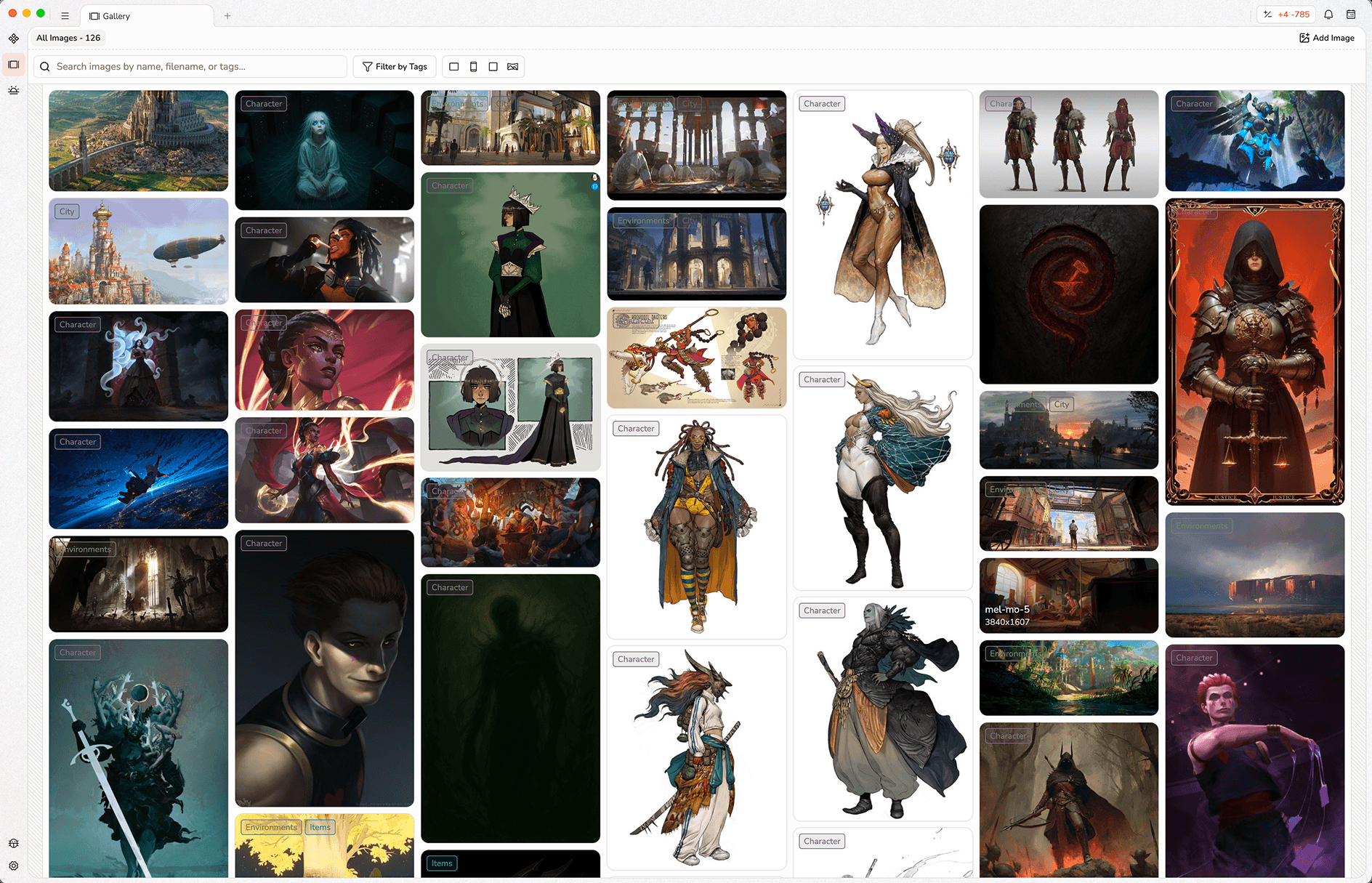
Stolen straight from pinterest. I like the idea of having all my inspiration in one place, where I can easily pull it up while writing instead of having to switch windows.
But enough of all that
Let me tell you how it actually works
It usually starts with a section
Prologue
“I write a small segment, a dialogue exchange, maybe some exposition. It is not a chapter and it doesn’t need to belong just yet. Later, when enough of them exist, I piece them together into something larger. The rest of the app grows around that process.”
Most of the time, I do not sit down to write a whole chapter. I write the piece that is actually ready first. Sometimes it is a simple encounter. Other times it is a whole chapter. It does not really matter. That is usually enough to begin moving.
What matters is that it can exist as its own unit. In the app, that unit is a segment. A segment can be a scene, a section, a chapter opening, a bit of dialogue, or a descriptive passage that I do not want to lose.
That is the freedom I wanted. I do not want the tool assuming I know the final shape at the beginning, because I usually do not.
Lets see..
This is why the segment matters
You do not need to know what the final chapter is yet. You just need somewhere to keep the piece while it still has life in it.
Once I have enough segments, the manuscript starts to become visible. Not because I planned every level in advance, but because the pieces have started giving me something real to arrange.
This is the part I care about most, because when I am ready, I can assemble those pieces together like lego. A handful of segments can become a larger section. Those sections can become acts. Eventually they become a completed manuscript.
That is why I built the writing side this way. I wanted the freedom to write in pieces first and only become strict about structure when the draft itself was ready for it.
Lets see..
This is where the book starts to appear
Once you have enough pieces, you can start building something larger out of them. The structure comes after the writing, not before it.
The other side of the project is made of concepts, but I do not think concepts should be limited to one fixed list. Some will be obvious. Characters, locations, factions, items, and events all fit there naturally.
But the real point is that a concept can be whatever you decide matters. It can be a religion, a kind of magic, a bloodline, a law, a war, a custom, a prophecy, a political office, or some strange thing that only exists in this one project.
That flexibility matters because narrative logic is never as tidy as software categories want it to be. If the story needs a new kind of thing, the app should make room for it instead of refusing it.
Lets see..
The idea only needs to matter to your story
Concepts are broad on purpose. If something needs to exist as its own thing in the project, you should be able to make it one.
Once the concepts exist, they still need context. That is where relationships come in. The useful part is not just storing the things, but deciding how they actually touch each other.
So the writer gets to decide the links too. Two people can be siblings, rivals, lovers, allies, debtors, teachers, traitors, heirs, or strangers who only cross paths once. A city can belong to an empire. A relic can be carried by a character. A cult can serve a god. The relationship is yours to define, because the narrative logic is yours.
Then time can be attached to those ideas as well. A concept can have a date, or it can have a period of time. An event can be a concept with a date attached to it. A character can be a concept with a birth date. That is how the draft starts holding not just what things are, but when they matter.
Lets see..
This is what gives the project context
Relationships and time are what stop the surrounding material from becoming a pile of notes. They keep the draft connected to the world around it.
Let's see what direction the community is swaying ;)
Writality is everything I've ever wanted in a writing software and more 🐰💕 Thank you so, so much to Venus for creating Writality—and for being so receptive to user feedback. It combines most every feature I've ever longed for into a single pleasant writing software, seamlessly integrating them in such a way that no one feature feels intrusive. It somehow manages to remain feature-rich yet minimalist in design, with a modern UI that tickles the creative in me. Unsurprisingly, the new Zen Mode and Focus tools are my most anticipated and favorite features right now, but I am in love with the binder structure and Concepts and the Dashboard and tags and . . . I suppose just everything, haha! The UI and themes are spot-on and wonderful. Writality truly does have that splendid feel of a writing software created for writers first and I cannot express how much I appreciate that. Oh, and it's free, which still boggles me! So, thanks again for Writality, Venus! Thank you so, so much. I look forward to seeing how Writality evolves over time and hope to be around the entire way 🐧💗
I don't know exactly where to say this, so I will do it here. I have found Writality by happenstance. It was a great find. I'm a first time writer, have never written anything before (although I read a lot). One day I woke up with this story in mind. Tried to find tools to help me write. Scrivener... and also many other indie apps... but none of them clicked exactly with me. Some of them almost hit the spot, but in the end they were strict in a point or another. I have this kind of monkey brain. I change my mind all the time. I want to have free form characters, curses, places... relationship. And then I found Writality and... I'm so grateful because it feels that someone finally understood the way my mind works!! I don't know who the devs are (now I know, Venus—you're the one!), but I'm sure they're here so, hear me please: thank you a million times, and thank you for making all of this available for free. That really means a lot, God bless you. I hope you keep developing this amazing tool for many years to come 🤗🙏
I tried almost every software/app with the exception of services with monthly fees because I don't like that monetization model at all. When I tried other worldbuilding/writing apps I suffered old/ugly UIs, too rigid structures, too simplistic tools, convoluted menus and systems, bugs, crashes, data loss, etc, etc. Then I tried Notion and many clones. At first I was happy because I had the power to make my own systems and structures, but after many hours I realised I was just wasting time refining the system instead of actually writing or worldbuilding. Writality is the closest to what I need: it has a robust yet simple set of features, easy to learn but powerful enough. The UI is clean and nice, it has night mode/dark themes (a must for me) and it's FREE! On top of that, the dev is friendly, patient, replies to bug reports and listens to the community. This is a dream come true.
Just wanted to say that I've been writing in Writality for a month (and love it) but today is the first day I've clicked on 'Text Insights' on a chapter I was editing, and I was kind of blown away. So, 1. Awesome Job Again and 2. THANK YOU! (again!)
I have just started using Writality. I have been using it for half a month. BUT, I am obsessed with it. First of all, the Text Insights 👨🍳💋 chef's kiss. I love how I can edit the chapters. It shows the sentence lengths, paragraph density and so on. I was flabbergasted when I first opened it. It is sooo awesome. Secondly, I am obsessed with the themes. All the customized themes that I can create or import from the lovely community. Thirdly, the fact that I can create maps inside it. And and and, Kanban board!!! AAAAAAA!!!! So many things in one place, how can I not love this? Also love how the dev actively listens to the community feedback and works on it. I recommend this. Most importantly, thank you for making this awesome software and much love!
Writality is everything I've ever wanted in a writing software and more 🐰💕 Thank you so, so much to Venus for creating Writality—and for being so receptive to user feedback. It combines most every feature I've ever longed for into a single pleasant writing software, seamlessly integrating them in such a way that no one feature feels intrusive. It somehow manages to remain feature-rich yet minimalist in design, with a modern UI that tickles the creative in me. Unsurprisingly, the new Zen Mode and Focus tools are my most anticipated and favorite features right now, but I am in love with the binder structure and Concepts and the Dashboard and tags and . . . I suppose just everything, haha! The UI and themes are spot-on and wonderful. Writality truly does have that splendid feel of a writing software created for writers first and I cannot express how much I appreciate that. Oh, and it's free, which still boggles me! So, thanks again for Writality, Venus! Thank you so, so much. I look forward to seeing how Writality evolves over time and hope to be around the entire way 🐧💗
I don't know exactly where to say this, so I will do it here. I have found Writality by happenstance. It was a great find. I'm a first time writer, have never written anything before (although I read a lot). One day I woke up with this story in mind. Tried to find tools to help me write. Scrivener... and also many other indie apps... but none of them clicked exactly with me. Some of them almost hit the spot, but in the end they were strict in a point or another. I have this kind of monkey brain. I change my mind all the time. I want to have free form characters, curses, places... relationship. And then I found Writality and... I'm so grateful because it feels that someone finally understood the way my mind works!! I don't know who the devs are (now I know, Venus—you're the one!), but I'm sure they're here so, hear me please: thank you a million times, and thank you for making all of this available for free. That really means a lot, God bless you. I hope you keep developing this amazing tool for many years to come 🤗🙏
I tried almost every software/app with the exception of services with monthly fees because I don't like that monetization model at all. When I tried other worldbuilding/writing apps I suffered old/ugly UIs, too rigid structures, too simplistic tools, convoluted menus and systems, bugs, crashes, data loss, etc, etc. Then I tried Notion and many clones. At first I was happy because I had the power to make my own systems and structures, but after many hours I realised I was just wasting time refining the system instead of actually writing or worldbuilding. Writality is the closest to what I need: it has a robust yet simple set of features, easy to learn but powerful enough. The UI is clean and nice, it has night mode/dark themes (a must for me) and it's FREE! On top of that, the dev is friendly, patient, replies to bug reports and listens to the community. This is a dream come true.
Just wanted to say that I've been writing in Writality for a month (and love it) but today is the first day I've clicked on 'Text Insights' on a chapter I was editing, and I was kind of blown away. So, 1. Awesome Job Again and 2. THANK YOU! (again!)
I have just started using Writality. I have been using it for half a month. BUT, I am obsessed with it. First of all, the Text Insights 👨🍳💋 chef's kiss. I love how I can edit the chapters. It shows the sentence lengths, paragraph density and so on. I was flabbergasted when I first opened it. It is sooo awesome. Secondly, I am obsessed with the themes. All the customized themes that I can create or import from the lovely community. Thirdly, the fact that I can create maps inside it. And and and, Kanban board!!! AAAAAAA!!!! So many things in one place, how can I not love this? Also love how the dev actively listens to the community feedback and works on it. I recommend this. Most importantly, thank you for making this awesome software and much love!
Not only did Venus create a fantastic piece of software, they are also the kindest, most patient soul on the planet and helped me find, figure out and get my data restored when I thought that I'd lost most of it. So thank you for being super patient and thank you for an amazing software. You are the best.
It's clear to me how much love and care is going into making this piece of software. A writing app made by a writer for writers. The intention and statement of belief that writing software should be free for all made me smile because I 100% agree. Any gatekeeping when it comes to creativity only harms and never supports. I love all the features and the UI. It's made my return to writing so smooth. Thank you for bringing this to the world!
 Alan A. MehannaScreenwriter, writer, published poet, TEDx speaker
I feel like it's time to finally make a verdict. Writing softwares collect on my drives like pretty pebbles—something shiny, something new. But never any of them felt right or enough. Now, I only used most of them for less than a day or two. Some made it past a month until I didn't want to deal with them anymore, because I had so many issues with them. And then I came across Writality. This writing software is free, and this one can, in my opinion, hold up with the ‘big shots’. It has all you need, nothing too fancy, easy to navigate and it has been a blast in these past few days/weeks. Additionally, you receive a nice little community and such a nice, considerate dev. I can't believe how well our feedback is taken and tried to be implemented. Needs are being met, you can launch right into the software, you can even make your own map! It's so well made and I've been growing my world in my project like a well-planted Calathea. I also love the ‘Picture-album’ you can add in each document. Especially because my characters have special items or outfits etc. It's like bringing my Pinterest into my project. Soooo nice. All I can say is thanks, to be honest. It has been so fun to write in this app and it's so comfortable. Thank you! 🐈
As someone who always made do with Word or LibreOffice and most recently a plug-in-filled Obsidian, there's just something magical about Writality. The feature sets and workflow may require some time to get used to and maximize their value, but at its core this software entices you to write instead of pressuring you to do so. It facilitates your style in a way that makes you excited. Even if there is something you may dislike or feel like something is lacking, the developer is active with discussing such requests and opinions. As of writing, the app is on version 1.7.7, and if it's already this good then I can't wait for what the future holds.
Worldbuilding was already a fun thing for me, but having the system in Writality has completely taken the experience to the next level. The intuitive connections between the writing and the worldbuilding is excellent, and through the process of creating concepts, I am inspired right in the moment to expand my world in ways that wouldn't happen if I was just writing the information in the manuscript. The relationships especially make a huge difference because I'm not satisfied to have a country or a mountain range ... I need animals and peoples to live in them to build an interconnected web of relationships. This app is taking my fantasy worlds to the next level almost effortlessly. The actual writing process is just as helpful. No other app that I tried was able to keep me coming back to use it because I actually wanted to (one did for a few days, but it, too, ultimately failed). With Writality, I'm pulled to either write or worldbuild everyday, and it doesn't feel like work to do it. ✨🐱 I've never been so happy to have a part in a development project (albeit it simply as a beta-tester). Thank you, Venus! 💕
I was trying out Writality, and I must say, it is wonderful. The features, possibilities, thought and care put into it make it a wonderful software for messy or structured planning. For being a beta app this is excellent. I've recommended it to some writer friends who aren't chronically online, and they are loving it!
As someone who's super interested in local-first software in the era of constant slop SaaS, this is an amazing project and surely one of the biggest inspirations for my own side-projects! The aesthetics are a bliss, with a great level of simplicity and usability still. Writing and worldbuilding is a hobby for me, and it feels really good to use Writality in small windows of time during my day.
Writality is really looking like the tool I've been needing for a while now. Notion and Obsidian can be overwhelming. Google Docs or Word aren't enough. Scrivener is powerful, but the UI feels dated. It isn't feature bloated, and it doesn't have an overwhelming amount of plugins. There's none of the same fatigue I feel with other systems, where I worry about optimizing instead of writing. It's very intuitive and approachable.
Not only did Venus create a fantastic piece of software, they are also the kindest, most patient soul on the planet and helped me find, figure out and get my data restored when I thought that I'd lost most of it. So thank you for being super patient and thank you for an amazing software. You are the best.
It's clear to me how much love and care is going into making this piece of software. A writing app made by a writer for writers. The intention and statement of belief that writing software should be free for all made me smile because I 100% agree. Any gatekeeping when it comes to creativity only harms and never supports. I love all the features and the UI. It's made my return to writing so smooth. Thank you for bringing this to the world!
Alan A. MehannaScreenwriter, writer, published poet, TEDx speakerI feel like it's time to finally make a verdict. Writing softwares collect on my drives like pretty pebbles—something shiny, something new. But never any of them felt right or enough. Now, I only used most of them for less than a day or two. Some made it past a month until I didn't want to deal with them anymore, because I had so many issues with them. And then I came across Writality. This writing software is free, and this one can, in my opinion, hold up with the ‘big shots’. It has all you need, nothing too fancy, easy to navigate and it has been a blast in these past few days/weeks. Additionally, you receive a nice little community and such a nice, considerate dev. I can't believe how well our feedback is taken and tried to be implemented. Needs are being met, you can launch right into the software, you can even make your own map! It's so well made and I've been growing my world in my project like a well-planted Calathea. I also love the ‘Picture-album’ you can add in each document. Especially because my characters have special items or outfits etc. It's like bringing my Pinterest into my project. Soooo nice. All I can say is thanks, to be honest. It has been so fun to write in this app and it's so comfortable. Thank you! 🐈
As someone who always made do with Word or LibreOffice and most recently a plug-in-filled Obsidian, there's just something magical about Writality. The feature sets and workflow may require some time to get used to and maximize their value, but at its core this software entices you to write instead of pressuring you to do so. It facilitates your style in a way that makes you excited. Even if there is something you may dislike or feel like something is lacking, the developer is active with discussing such requests and opinions. As of writing, the app is on version 1.7.7, and if it's already this good then I can't wait for what the future holds.
Worldbuilding was already a fun thing for me, but having the system in Writality has completely taken the experience to the next level. The intuitive connections between the writing and the worldbuilding is excellent, and through the process of creating concepts, I am inspired right in the moment to expand my world in ways that wouldn't happen if I was just writing the information in the manuscript. The relationships especially make a huge difference because I'm not satisfied to have a country or a mountain range ... I need animals and peoples to live in them to build an interconnected web of relationships. This app is taking my fantasy worlds to the next level almost effortlessly. The actual writing process is just as helpful. No other app that I tried was able to keep me coming back to use it because I actually wanted to (one did for a few days, but it, too, ultimately failed). With Writality, I'm pulled to either write or worldbuild everyday, and it doesn't feel like work to do it. ✨🐱 I've never been so happy to have a part in a development project (albeit it simply as a beta-tester). Thank you, Venus! 💕
I was trying out Writality, and I must say, it is wonderful. The features, possibilities, thought and care put into it make it a wonderful software for messy or structured planning. For being a beta app this is excellent. I've recommended it to some writer friends who aren't chronically online, and they are loving it!
As someone who's super interested in local-first software in the era of constant slop SaaS, this is an amazing project and surely one of the biggest inspirations for my own side-projects! The aesthetics are a bliss, with a great level of simplicity and usability still. Writing and worldbuilding is a hobby for me, and it feels really good to use Writality in small windows of time during my day.
Writality is really looking like the tool I've been needing for a while now. Notion and Obsidian can be overwhelming. Google Docs or Word aren't enough. Scrivener is powerful, but the UI feels dated. It isn't feature bloated, and it doesn't have an overwhelming amount of plugins. There's none of the same fatigue I feel with other systems, where I worry about optimizing instead of writing. It's very intuitive and approachable.
Mainly for SEO purposes, but in the event you want to read more about the thinking behind Writality, here are some snapshots and further reading.
Start from a simple idea, connect it and expand on it. Soon you will have a manuscript.